
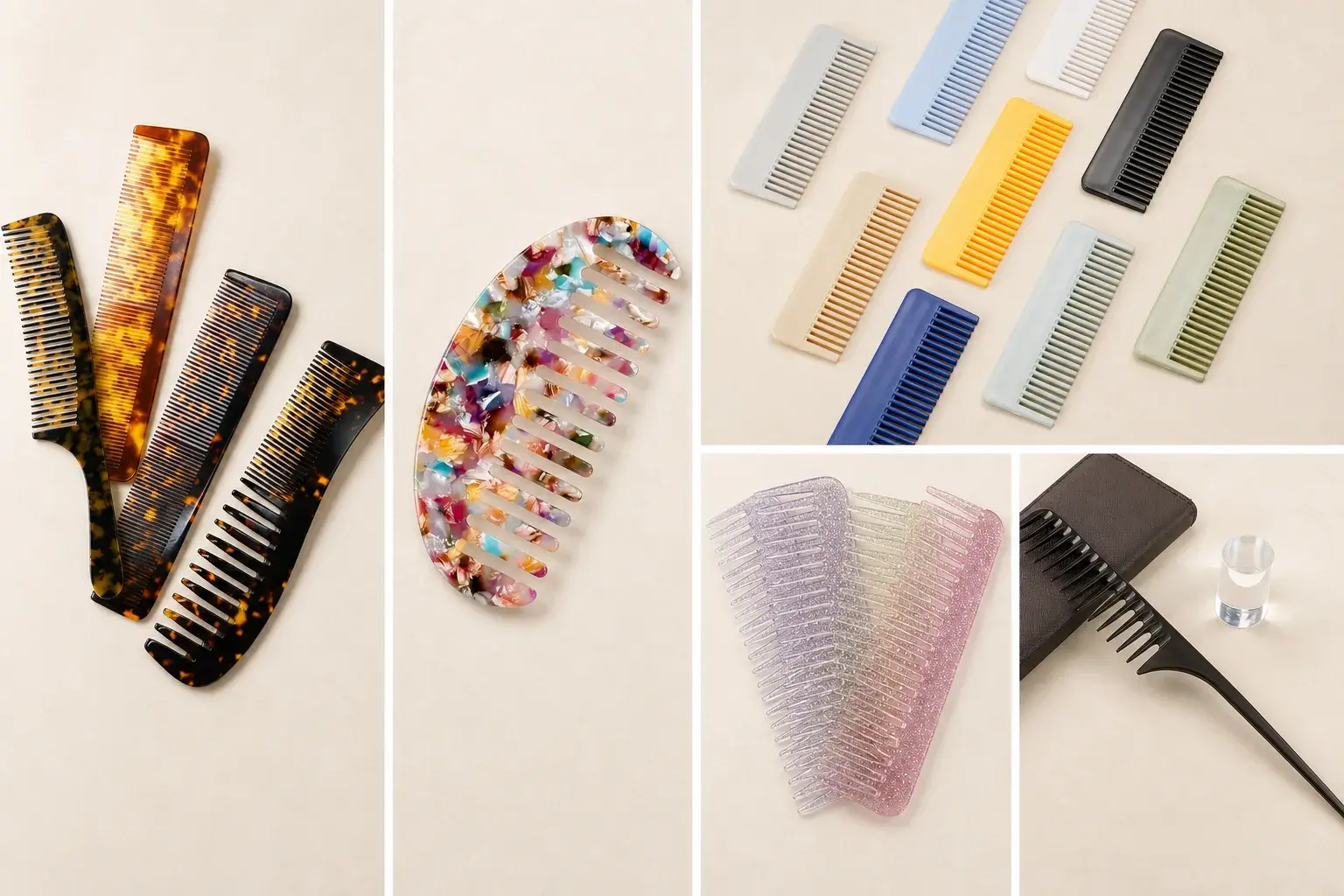
The quickest way to misunderstand acetate and plastic combs is to treat them as two finishes applied to the same product. They reach a similar silhouette by very different routes. One begins as a sheet that already has its color and pattern. The other begins as resin that takes its shape inside a mold.
That distinction reaches into nearly every decision that follows. It affects how a designer creates the outline, how the teeth and edges are finished, how closely one piece can match the next, and when a change may reopen tooling. A photograph can show which sample you like. It cannot tell you how that sample should be reproduced.
What “acetate vs plastic” means in a comb project
Cellulose acetate belongs to the broad family of plastic materials. In comb sourcing, however, people commonly use acetate for the sheet-cut route and plastic for the injection-molded route. This article follows that practical usage.
An acetate comb starts with a selected sheet pattern and thickness. The profile is cut, the teeth are machined, and the piece moves through sanding and polishing. An injection-molded comb starts with a selected resin and an approved mold. The mold forms the profile, teeth, handle, openings, and other molded details.
The material name alone says little about whether a comb is well made. A sound comparison needs the actual resin or sheet, the geometry, the finishing standard, and the approved production sample.
Start with the production route
With acetate, the sheet is already visible before the comb exists. Its pattern may run through the material, and cutting a new outline reveals that pattern along the face and polished edge. The maker still has to machine the tooth spaces, shape the tips and roots, smooth the edges, and bring the surface to the agreed finish.
With injection molding, the designer first has to know which geometry the tool can form. Resin, color preparation, mold construction, surface texture, molding conditions, and later operations all influence the finished part. The product comes out close to its final shape, though gates, parting areas, burrs, warping, surface marks, and dimensional consistency still need inspection.
| Decision | Sheet-cut acetate | Injection-molded plastic |
|---|---|---|
| Starting point | Physical sheet pattern and thickness | Resin, color system, drawing, and mold |
| How shape is made | Profile and teeth are cut or machined from sheet | Profile and teeth are formed in the mold |
| Appearance control | Approve the sheet and an acceptable pattern range | Approve color and surface on the selected resin |
| Edge character | Developed through shaping, sanding, and polishing | Defined largely by tool geometry and molding quality |
| Geometry change | May require new cutting files, fixtures, and samples | May require a new mold or mold modification |
| Main approval sample | Finished sample showing pattern, teeth, edges, and polish | Molded sample showing dimensions, color, surface, and function |
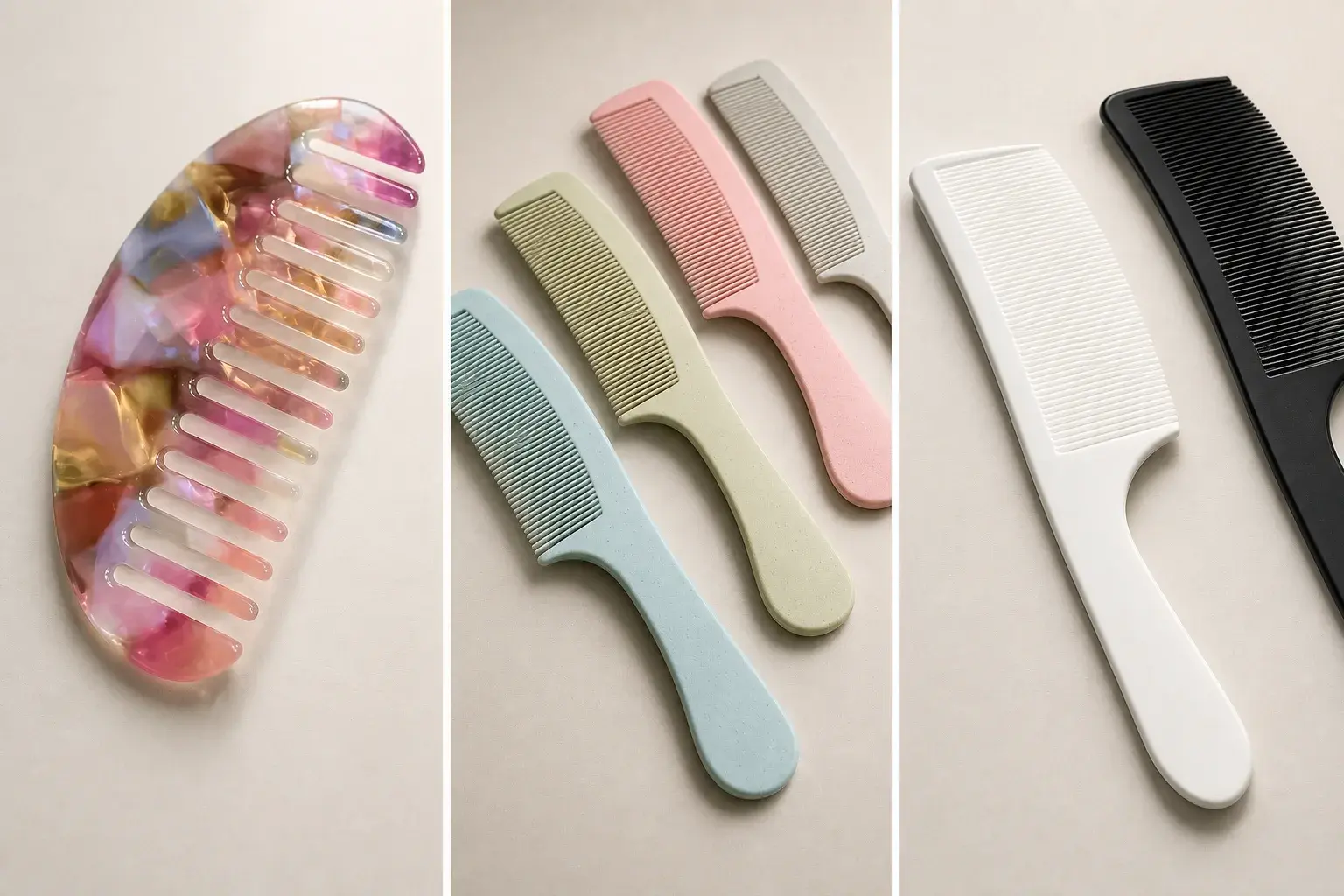
Appearance and repeatability are different questions
Acetate is usually chosen with the sheet in view. Patterned and layered sheet effects can create an appearance that a flat color reference does not capture. The same pattern may land differently on each cut piece. The approval should define a reasonable range so one photographed comb does not become an impossible promise for every unit.
A molded plastic comb can be developed in solid, transparent, translucent, or other confirmed color directions. Its color is generally planned for repeatable production, though the result still depends on the resin, texture, gloss, wall thickness, color preparation, and viewing conditions. Approve color on the actual material and surface. A screen value or Pantone reference can start the conversation, but it cannot finish it.
This is where buyers sometimes compare the wrong evidence. The acetate sample needs to prove the accepted pattern, polish, edge, and piece-to-piece range. The molded sample needs to prove resin color, surface, geometry, and molding quality. Asking both factories for a color chip leaves too much unanswered.
Shape freedom works differently
A sheet-cut comb can take many flat profiles without an injection mold. Changing the outer silhouette may call for a new drawing, cutting program, fixture, or sample, while the chosen sheet thickness still sets an important limit. Features extending beyond the flat profile may require separate parts, assembly, or another process, so they need their own feasibility review.
Injection molding handles repeatable three-dimensional geometry well once the mold has been developed and approved. The commitment comes earlier. A change to the profile, tooth layout, handle, opening, molded texture, or assembly feature may affect the tool. A new color, printed logo, or package often leaves the main product mold unchanged.
Before paying for tooling, compare a dimensioned drawing with the closest existing option. The mold review should identify exactly which feature forces a new tool and which requests can be handled after molding.
Teeth and edges deserve their own approval
Material choice cannot rescue poor tooth geometry. A comb still has to move through hair without rough tips, sharp edges, unwanted burrs, or an awkward transition between fine and wide sections.
On acetate, inspect the machined tooth spaces, roots, tips, side faces, outside edge, sanding marks, and final polish. Small changes in finishing can alter both the feel and the measured profile. On a molded comb, inspect the tooth shape, straightness, parting areas, gate-related areas where applicable, flash or burrs, warping, and consistency across the sample.
Write the important dimensions down. Terms such as fine tooth and wide tooth are useful descriptions, though they are not measurements. A controlled drawing should state the tooth spacing, length, thickness, root, tip, and measurement method wherever those details affect function.
Cost and order quantity need a real quotation
Quantity alone cannot establish which route costs less. Each route puts money into different parts of development and production.
Acetate avoids an injection mold, yet each piece still passes through cutting, tooth machining, sanding, polishing, inspection, and any later branding. Sheet selection, material yield, profile complexity, finish, and manual work all enter the quotation. A small quantity does not make those operations disappear.
Injection molding may carry a larger tooling commitment when an existing mold cannot be used. Once an approved tool is running, resin, color changes, later finishing, assembly, inspection, and packaging continue to affect unit cost. An existing-mold comb and a fully custom molded product need separate quotations.
Ask for the cost to be separated into material, development or tooling, samples, finishing, branding, packaging, and production quantity. Then compare the routes at the quantities you genuinely expect to order, including likely repeat orders.
Branding follows the finished surface
A logo method has to work with the actual material, available print area, artwork, surface, and desired visual effect. Screen, pad, or UV printing can add color where the surface and artwork allow it. Laser engraving may suit selected designs and materials. A raised or recessed molded mark belongs in the injection-molded geometry and can reopen tool review.
Supply vector artwork with the final size, position, colors, and orientation. Approve the mark on the finished comb. A logo that looks balanced on a flat drawing may sit too close to a polished edge, textured area, tooth field, or package holding point.
Packaging should wait for the finished dimensions and surface where fit is critical. A tight sleeve can scuff a polished acetate face. An insert can press against molded teeth or cover the logo. Check the comb and pack together before bulk production.
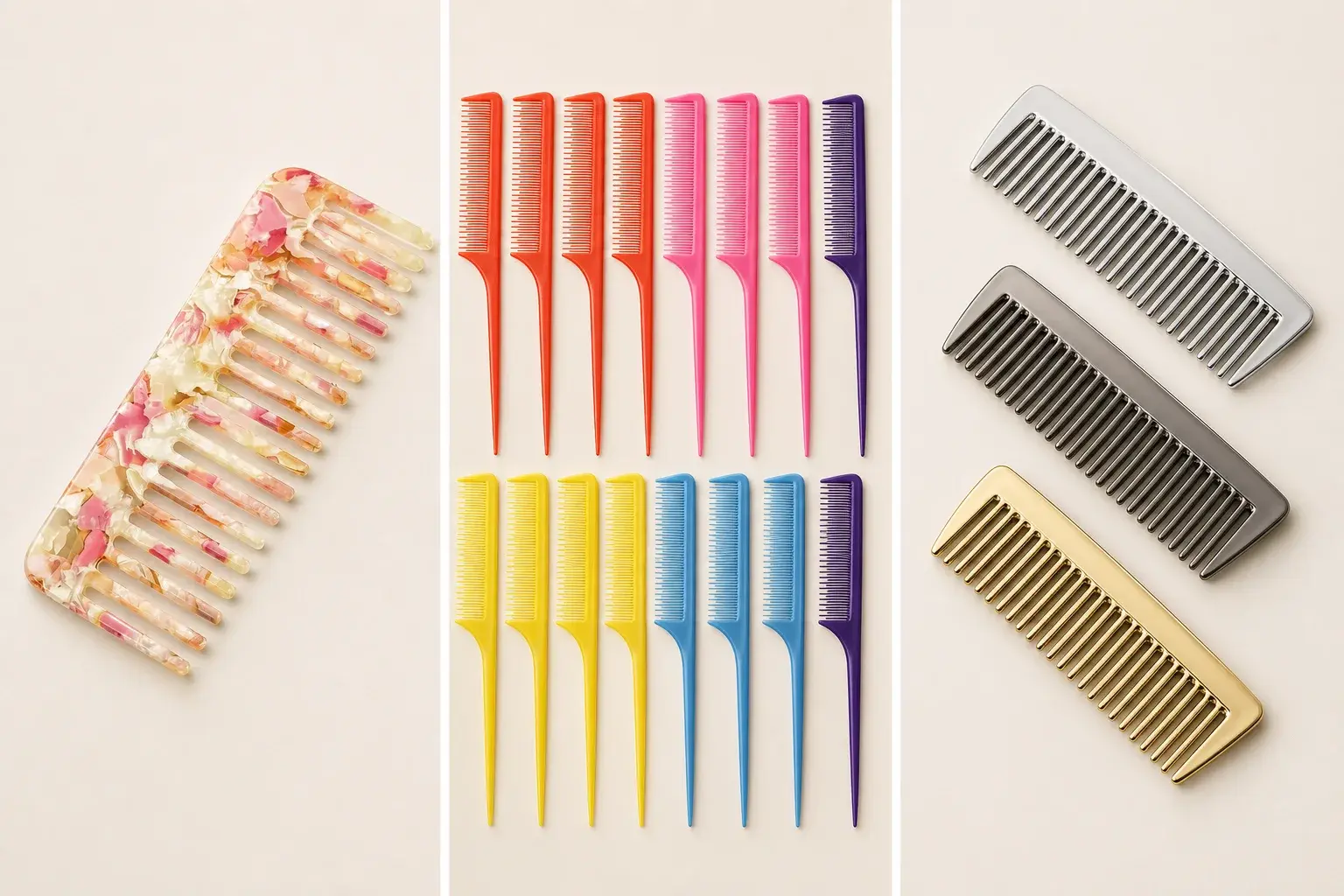
Choose from the product you are trying to make
Choose acetate when the identity of the comb comes from a particular sheet pattern, visible depth, a cut profile, and polished edges. Be ready to approve a physical sheet or finished sample and accept a defined amount of pattern variation.
Choose injection-molded plastic when the product depends on repeatable molded geometry, an existing tool, a custom three-dimensional structure, or a controlled solid or transparent color program. Be ready to settle the drawing and tooling questions before treating the color sample as final approval.
If both routes remain possible, put the same use case in front of each supplier. Use comparable length, thickness, tooth layout, logo size, packaging, quantity, and destination requirements. Two unrelated product photos reveal very little about which route fits the brief.
A useful brief for either route
A supplier can give a more meaningful answer when the brief includes the decisions that affect production.
- The intended use and comb type
- A physical reference or dimensioned drawing
- The required pattern, color, transparency, and finish
- The overall shape, thickness, tooth layout, handle, and components
- Logo artwork with size, method, color, and position
- Order quantity and realistic repeat-order forecast
- Packaging format, sales market, destination, and timing
- Any required material documents or tests
- The physical references that will control bulk production
One final question is worth putting in writing. Ask exactly what you will receive for approval and what that sample proves. A sheet chip proves the acetate pattern, not the finished teeth. A molded color plaque proves a color direction, not the comb dimensions. A finished sample should carry the decisions that matter into bulk production.